
Week 43, 19 - 25 October 2026
In this issue:
C. Visitors/ MoU/ Agreement Signing
1) Invitation—Advancing Disaster Resilience: AIT Symposium on 29 October 2026
Email from AIT President on 12 October 2026
I warmly invite you to participate in the symposium, “Advancing Disaster Resilience in Asia through Research, Innovation, and Partnerships,” with a special focus on Resilient Rehabilitation and Recovery in Nepal, to be held on 29 October 2026, from 12:30 p.m. to 4:30 p.m., at the Milton Bendor Auditorium, AIT.
As climate-related disasters become increasingly complex and interconnected across Asia, stronger collaboration between science, technology, policy and practice is essential. This symposium will bring together AIT experts, government representatives, development partners and resilience practitioners to explore practical approaches to disaster risk reduction, rehabilitation and recovery. Drawing on Nepal’s recent Rasuwa–Bhotekoshi flood, discussions will examine how research, innovation and partnerships can support resilient recovery and help communities build back better.
The program will showcase AIT’s research, technological innovations and training initiatives, followed by presentations and discussions on Nepal’s recovery priorities and challenges. It will also provide opportunities to explore collaboration, technical assistance, capacity development, technology transfer and joint initiatives to strengthen disaster resilience across the region.
I encourage faculty, staff, and students across AIT to participate. Your expertise, perspectives and engagement will be invaluable in strengthening AIT’s contribution to evidence-based disaster resilience and sustainable development in Asia.
For registration and detailed information, including the concept note, provisional agenda and latest updates, please visit the symposium event page: View event details and register
I look forward to welcoming you to this important event.
| Time | Session |
|---|---|
| 12:30–13:00 | Registration |
| 13:00–13:10 | Opening Session — Welcome remarks by the AIT President |
| 13:10–14:30 | Session I: Scientific, Technological and Academic Contributions for Resilience Building in Asia — Keynote presentation and thematic presentations on AIT’s research, innovation and training initiatives |
| 14:30–15:00 | Networking and Refreshment Break |
| 15:00–16:15 | Session II: Nepal’s Recovery Needs and Challenges — Keynote address and moderated panel discussion |
| 16:15–16:30 | Closing Session — Key takeaways, next steps and closing remarks |

3) Interim Transition and Oversight Arrangement for OFAM
Email from AIT President on 8 October 2026
In this capacity, Dr. Dong and Dr. Santoso will work closely with the VPAD and the OFAM leadership to strengthen institutional and systemic integration, and facilitate the transition toward the planned management arrangement for OFAM.
This interim arrangement is intended to support continuity of operations and a smooth transition in OFAM leadership while strengthening the Institute's facilities and asset management capacity.
We thank Dr. Dong and Dr. Santoso for taking on these additional responsibilities and ask for the cooperation and support of the AIT community during this transition period.
4) PA-2-1-2 -- Re: New P&P Annexes of FS-9-2-2 and Revised P&Ps and Annexes: MoA Template of AA-1-2-6; FB-1-2-2; Annex 2 of FB-2-2-1; PA-2-1-2 and its Annex 2
Email from the Director, Office of Academic Administration on 23 September 2026
- Defines the categories of non-residential AIT space and establishes the applicable space charging framework, rates, principles, and exceptions.
- Identifies and groups AIT institutional units according to the space classifications established under Annex I.
- Provides the standard form for requesting space, including the required unit information, space requirements, review, recommendation, and approval.
- Added a new Item X.3 under Article …..: Duration, Termination, and Amendment, requiring both parties to comply with AIT’s Policy on Ethical Behavior and Grievance Process (PA-2-1-2), including requirements on the prevention of and protection from sexual exploitation and abuse (PSEA), throughout the implementation of the engagement.
- Revived and updated the previously unpublished P&P on AIT Funds: Accounting and Coding ( FB-1-2-2), as well as consolidated relevant provisions of the earlier unpublished P&P on Accounting Policies (FD-4-1) and on Accounting Procedures (FD-5-1), and aligned AIT’s fund accounting, fund classifications, accounting principles, and coding framework with current institutional practices and applicable accounting standards.
- Clarified the RCM allocation cost basis: specified that the 20% allocation on research project income is based on cash collection and excludes Internal Service Income; introduced/specified a 5% allocation on Conference Project Income based on cash collection; and established space-utilization charges of THB 350/sq.m./year for air-conditioned space and 40% of that rate for non-air-conditioned space.
- The space-utilization provisions under this Annex will apply only until 31 December 2026, after which FS-9-2-2 will apply from 1 January 2027.
- The revised RCM methodology shall be implemented with effect from 1 January 2026.
- Added stipulations and measures for the prevention of and protection from sexual exploitation and sexual abuse (I.A.3; II.A.8-9; III.A.1, 3-4; III.B.1.a-d; IV.A.2; IV.B.1.e-f; IV.B.2.a and Annex 2: Organizations and assistance service providers in Thailand that support victims of sexual abuse, exploitation, trafficking, or related gender-based violence)
5) Introducing our New Employees
We are delighted to welcome the newest members of the AIT family. Let us all wish them a successful and fulfilling journey with us.
Welcome aboard!

6) Know our Researcher series: September Edition Featuring Dr. Avirut Puttiwongrak
Email from SCPO on 15 September 2026
This series aims to make the AIT community and its external stakeholders aware of the diverse array of quality research being undertaken at the Institute by its reputed researchers.
This month's Edition: features Dr. Avirut Puttiwongrak, Assistant Professor from the Faculty of Civil and Environmental Engineering.
Visit the Web link: https://ait.ac.th/know-our-researcher/
7) September 2026 Yellow Bin Observation - Your contribution matters - Your small action saves Environment
Email from Director, OSC on 2 October 2026
The Office of Sustainable Campus (OSC) is pleased to share the results of the September 2026 Yellow Bin Observation, conducted with the support of our dedicated student assistants and interns. The observation reviewed waste segregation practices in yellow bins across academic buildings, staff and faculty areas, student dormitories, and Student Village residences.
We are pleased to see continued participation across the AIT community. Based on the September visual observations, staff and faculty areas showed comparatively better waste segregation, followed by student dormitories. Academic buildings showed several contamination issues, while Student Village areas continue to require greater attention to proper waste segregation.
Recognition for Yellow Bin Locations with Lower Visible Contamination
Based on the September observation, the following locations showed comparatively lower visible contamination at the time of inspection:
Food & Agricultural, OFAM, Dorm B, Dorm A, Muslim Prayer Hall, Dorm V, ST11, Substation 12, Registry Office, and Accommodation Office.
Other observations of contamination
We appreciate everyone's efforts; proper segregation helps improve recycling efficiency, protects recyclable materials from contamination, and supports our recycling partners in recovering valuable resources. At the same time, the September observation identified several recurring contamination issues across campus. Of particular concern, Food waste was observed in academic areas, while fruit waste was found in a staff and faculty area. Student Village continued to show repeated black and mixed waste bags, particularly across the observed SV1–SV3 locations. Black or opaque garbage bags remained the most noticeable recurring issue and were observed across academic buildings, staff and faculty areas, student dormitories, and Student Village.
A Friendly Reminder
Please place only clean, dry, and accepted recyclable materials in yellow bins, such as empty and clean plastic bottles, clean plastic containers, clean recyclable packaging, clean paper, dry flattened cardboard, newspapers, and magazines.
Please keep food and fruit waste, food-contaminated packaging, used tissues and napkins, foam food containers, black or opaque bags containing mixed waste, wet or oily paper and cardboard, leaves and garden waste, and general household waste out of the yellow bins.
A simple rule to remember is:
CLEAN + DRY + RECYCLABLE = YELLOW BIN
We sincerely thank all members of the AIT community for your continued cooperation. We also extend our appreciation to our student assistants and interns for supporting the monthly observations and documenting the findings.
Small choices today can create a more sustainable tomorrow. Together, let’s keep AIT clean, green, and responsible.
Email from the Office of Human Resources Services on 21 September 2026
To maintain accurate tax records in compliance with applicable regulations, we kindly request that you log in tohttps://hris.ait.ac.thusing your AIT email account, select 'View Employee Profile', and verify or update your personal details
Please kindly review and update the following as needed.
1. Contact information: personal phone number and residence address
2. Passport number and details of your dependents. Please ensure that the information regarding your child and spouse in the system is up to date. If they are studying or working in Thailand or abroad, kindly update the system accordingly.
3. Next of Kin: make sure that you have provided all the necessary details in the "Next of Kin" section. The next of kin should not be the same person listed as your direct dependent in HRIS. In the event of an emergency when you are incapacitated or if there are no other family members with you, the next of kin will be contacted by AIT.
Any changes in your personal data from the previous to the current year should be supported with documents in hard copies. These include passport copy, marriage certificate, child's birth certificate, house registration as well as receipts of investment in retirement mutual fund (RMF), personal health insurance, and personal long-term life insurance. For more information about tax deductions and allowances, click this link.
Please submit it to Khun Lalana in the Office of Human Resources Services (OHRS), Room 223, Second Floor of the Administration Building by 16 October 2026.
Thank you for your cooperation.
9) Blood Donation Announcement
Email from AIT Medical Center on 2 October 2026
The Thai Red Cross Society has been working with volunteer students and staff to collect units of blood from the AIT community. The bloodmobile visits AIT every three months, four times a year, hoping to collect enough units to supply the constant demand for blood.
Give blood! You'll experience a fulfilling sense of contribution. And the donation process isn't time-consuming. It only takes about half an hour. For more information, please click.
Workshops/ Trainings/ Conferences
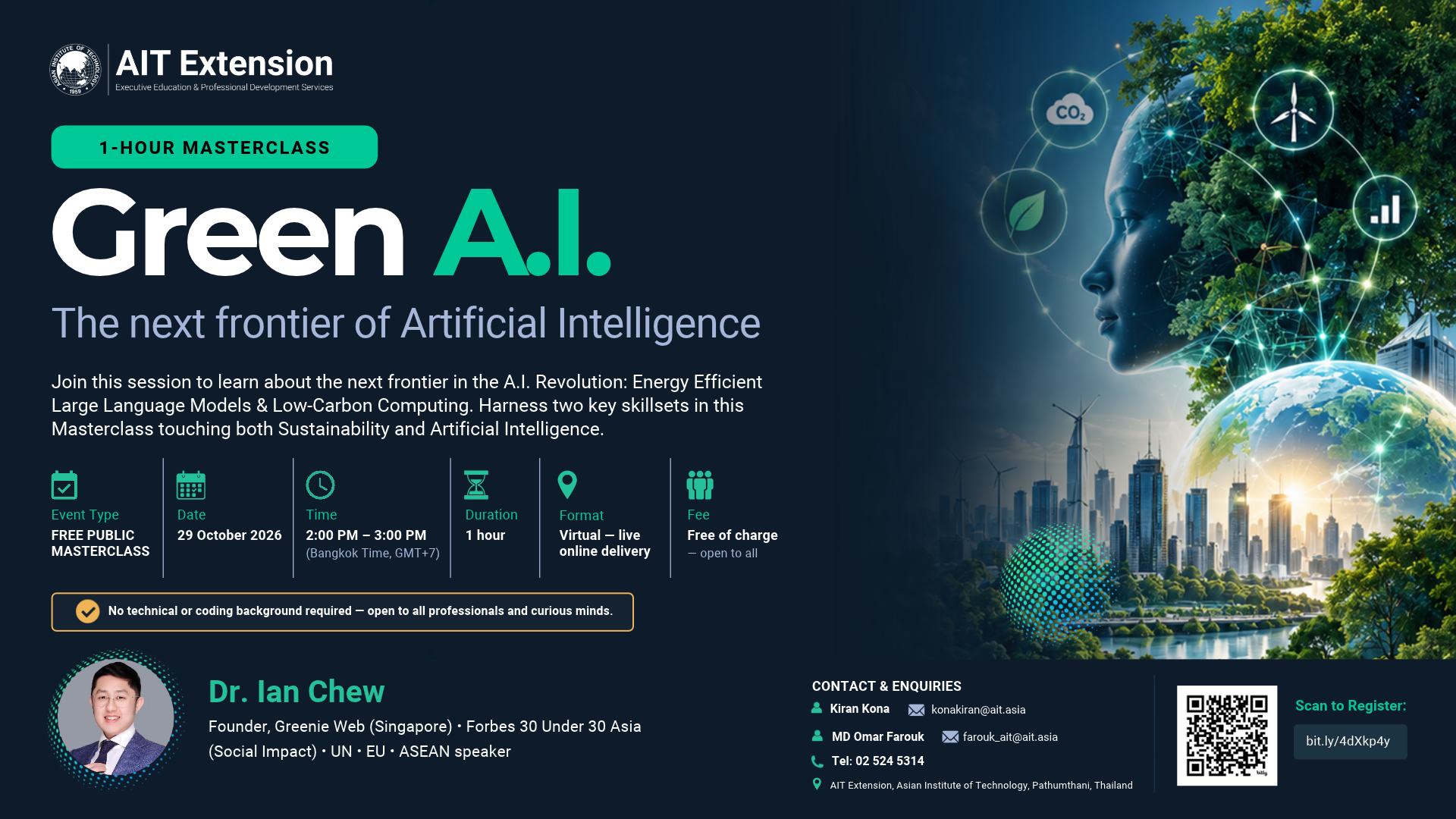
A Free 1-Hour Masterclass by AIT Extension
As artificial intelligence continues to advance, its growing energy consumption and environmental footprint are becoming critical considerations for businesses, policymakers, and technology professionals. Green AI offers a pathway toward developing and using AI more efficiently while supporting environmental sustainability and responsible digital transformation.
AIT Extension invites professionals, organizational leaders, policymakers, and individuals interested in AI and sustainability to join this free online masterclass exploring the emerging field of Green AI and its implications for a more sustainable digital future.
About the Masterclass
This engaging one-hour session will examine the relationship between artificial intelligence, energy efficiency, and environmental sustainability. Participants will gain insights into the energy and carbon costs associated with AI, explore energy-efficient Large Language Models (LLMs) and low-carbon computing strategies, and discover how organizations can incorporate greener digital practices into their operations.
The masterclass will also introduce emerging developments in AI sustainability frameworks and policy, helping participants understand the opportunities and challenges of advancing responsible, resource-efficient AI.
What You Will Learn
- Why Green AI matters in today’s rapidly evolving digital landscape.
- The energy consumption and carbon footprint associated with AI technologies.
- Energy-efficient Large Language Models (LLMs) and low-carbon computing strategies.
- Practical tools and approaches for organizations and professionals.
- Global developments in AI sustainability frameworks and policy.
Who Should Attend?
This masterclass is designed for:
- Business Leaders and Executives exploring sustainable digital strategies.
- Policymakers and Government Officials shaping digital sustainability regulations.
- IT and Technology Professionals developing, implementing, or managing AI systems.
- Sustainability Officers and Practitioners integrating environmentally responsible digital practices.
- Professionals and Curious Minds interested in the future of AI and sustainability.
No technical or coding background is required. The session is open to participants from all professional backgrounds.
Featured Speaker
Dr. Ian Chew
Founder of Greenie Web (Singapore), Forbes 30 Under 30 Asia honoree in Social Impact, and a speaker engaging with the United Nations (UN), European Union (EU), and ASEAN.
Event Details
- Event: Green A.I.: The Next Frontier of Artificial Intelligence
- Type: Free Public Masterclass
- Date: 29 October 2026
- Time: 2:00 PM – 3:00 PM (Bangkok Time, GMT+7)
- Duration: 1 hour
- Format: Live online delivery
- Registration Fee: Free of charge
Registration
Discover how AI innovation and environmental sustainability can advance together. Join this masterclass to explore practical approaches to energy-efficient AI and contribute to a more sustainable digital future.
Register now: https://extension.ait.ac.th/course/green-ai-next-frontier-artificial-intelligence
For further information, please contact:
Kiran Kona — konakiran@ait.asia
MD Omar Farouk — farouk_ait@ait.asia
Telephone: +66 2 524 5314
Organized by AIT Extension, Asian Institute of Technology, Thailand.

2) Tropical Finfish and Crustacean Aquaculture: Professional Short Course Series Integrating Seed Production, Sustainable Farming, Health Management, and Smart Aquaculture Technologies
Date: 30 August - 24 October 2026
Venue: Asian Institute of Technology (AIT), Thailand
As global demand for aquatic food continues to rise, the aquaculture sector faces the challenge of balancing higher productivity with sustainability, aquatic animal health, and climate resilience. In response, AIT Extension, in collaboration with the Aquaculture and Aquatic Resources Management (AARM) Program and FutureFish, offers the Tropical Finfish and Crustacean Aquaculture: Professional Short Course Series.
This series brings together three specialized training programs — Tilapia Farming, Sustainable and Smart Shrimp Farming, and Mud Crab Hatchery and Farming — equipping participants with practical knowledge and hands-on experience across the aquaculture value chain, from seed production and hatchery management to grow-out systems, aquatic animal health, sustainable farming practices, and smart aquaculture technologies.
More details: https://extension.ait.ac.th/course/tropical-finfish-and-crustacean-aquaculture-professional-short-course-series-integrating
extension@ait.ac.th | +66 2 524 5338 / 6100

 3) Mud Crab Hatchery and Farming: Hatching, Larval Rearing, Grow-out, and Soft-Shell Crab Production
Date: 18 – 24 October 2026
Venue: Asian Institute of Technology
Course Introduction
This course introduces participants to integrated mud crab hatchery and farming systems, covering the complete production cycle from broodstock management and natural hatchery operations to larval rearing, grow-out, fattening, and soft-shell crab production. Through a combination of expert-led lectures, hands-on practical training, laboratory and pond sessions, and technical visits to commercial mud crab farms in Thailand, participants will gain practical knowledge and industry-relevant skills to improve production efficiency, strengthen biosecurity, and promote sustainable mud crab aquaculture.
This program covers:
1. Mud crab species identification, biology, moulting, reproduction, and life cycle
2. The mangrove ecosystem’s role in crab productivity; site selection for pond-based hatcheries
3. Pond design, preparation, and management for mangrove-based natural hatchery systems
4. Broodstock selection, transport, conditioning, and management of berried females for spawning
5. Natural larval production: stage identification, live-feed culture (microalgae, rotifers, Artemia), and feeding schedules
6. Water quality management (salinity, temperature, DO, pH, ammonia, alkalinity)
7. Nursery rearing: stocking density, shelter/substrate management, feeding, grading, and cannibalism reduction
8. Grow-out, fattening, and soft-shell crab production — stocking, feeding, moult induction, and harvest timing
9. Disease management, biosecurity, predator control, and post-harvest handling
10. Farm economics, marketing channels, and Group Action Plan (GAP) development
Key Learning Outcomes:
1. Identify mud crab species and describe their biology, life cycle, and habitat requirements.
2. Design, prepare, and manage mangrove-based ponds for natural hatchery and larval rearing.
3. Select, condition, and manage broodstock; oversee spawning, egg incubation, and larval development.
4. Apply nursery rearing techniques for crablets, including live-feed, water quality, and grading.
5. Operate grow-out, fattening, and soft-shell crab production in pond and tank systems.
6. Manage feed programmes, disease risks, biosecurity, harvesting, and post-harvest handling.
7. Evaluate farm economics and develop practical action plans for implementation.
For more information and registration, please visit https://extension.ait.ac.th/course/mud-crab-hatchery-and-farming-hatching-larval-rearing-grow-out-and-soft-shell-crab

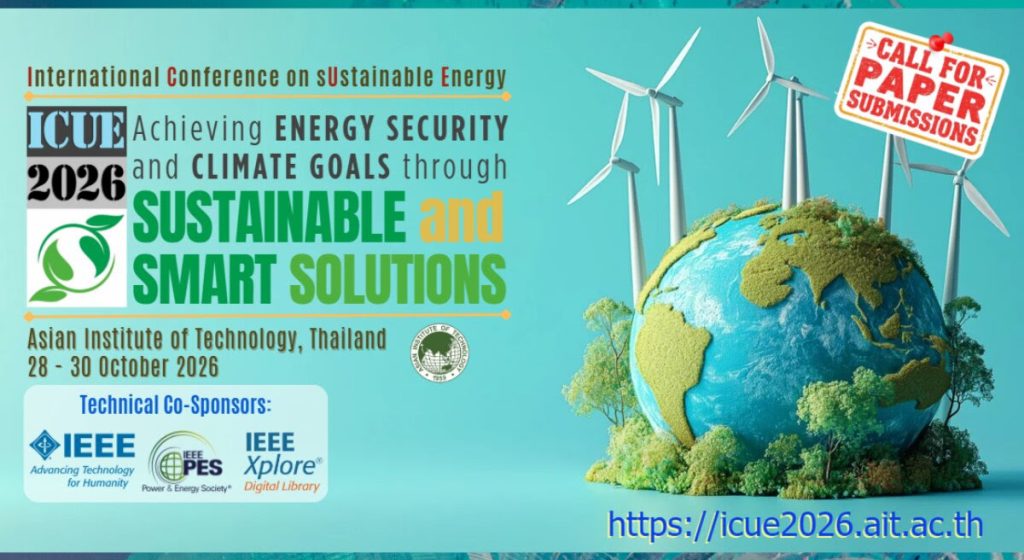
4) The International Conference on Sustainable Energy (ICUE 2026)
The Asian Institute of Technology (AIT) is proud to host the International Conference on sUstainable Energy (ICUE 2026) from 28–30 October 2026 in Thailand. Technically co-sponsored by the IEEE Power and Energy Society (IEEE PES), this year’s ICUE edition focuses on the intersection of climate goals, energy security, and digital innovation under the theme “Achieving Energy Security and Climate Goals through Sustainable and Smart Solutions”.
The Technical Program Committee of the ICUE 2026 is officially inviting applications for Special Session Organizers. We encourage you to read the full details (i.e. guidelines, relevant dates, proposal submissions) available at this link here: Call for Special Session Organizer.
Organizer Requirements:
• Session Scope: Titles and themes must align with ICUE 2026 Key Conference Themes.
• Composition: Each session requires at least 10 fully paid/registered papers and at least one contributor from overseas.
• Logistics: One organizer must be physically present at the venue to conduct the session.
• Application: Submit the official form including a session title, abstract (200–300 words), technical outline (150–180 words), and organizer CVs.
Organizer Benefits:
• Registration Waivers: Main organizers receive a 50% to 75% fee waiver based on the number of registered papers (10 or 15), inclusive of a lead paper.
• Accommodation: One twin-bed sharing room at the AIT Conference Center hotel is provided during the conference dates. Airfare, local transportation, and allowance will not be provided.
Interested special session organizers should submit their application and proposal along with the brief CV via email: icue2026@ait.ac.th. Please use the downloadable form from here: Call for Special Session Organizer.
Please Visit Our Website (https://icue2026.ait.ac.th) for More Information
| Important Dates to Remember 31 March 2026 Due Date for Paper Submission. 15 May – 30 June 2026 Notification of Acceptance (PAPER). 31 July 2026 Camera-ready PAPER Submission Deadline. 15 August 2026 End of Early-Bird Registration period. 28 – 30 October 2026 CONFERENCE |
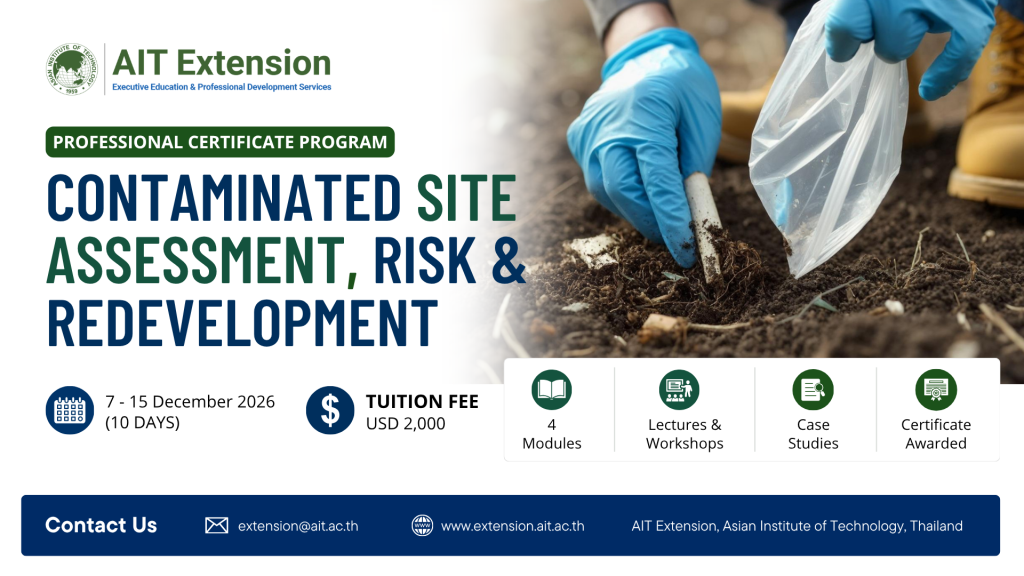
5) Professional Certificate Program: Contaminated Site Assessment, Risk & Redevelopment
AIT Extension, Asian Institute of Technology, invites professionals and emerging practitioners to join the Professional Certificate Program: Contaminated Site Assessment, Risk & Redevelopment, taking place from 7–15 December 2026 at the Asian Institute of Technology, Thailand.
This intensive 10-day program strengthens participants’ capacity to assess, manage, and remediate contaminated sites through an integrated approach combining scientific investigation, risk evaluation, and practical decision-making across the full site-management cycle.
Who Should Attend
- Environmental engineers and consultants
- Government regulators and policymakers
- Urban planners and developers
- Oil, gas, and industrial professionals
- Banking, investment, and ESG professionals
- Academics and postgraduate students
Program Highlights
- Environmental Site Assessment: Phase I, II, and III ESAs; soil and groundwater investigation; sampling strategies; QA/QC; and reporting.
- Remediation and Risk-Based Decision-Making: Remediation technologies, risk-based corrective action, cost-risk optimization, and site-closure strategies.
- Liability and Brownfield Redevelopment: Liability frameworks, transaction due diligence, financial and regulatory risks, and redevelopment strategies.
- Practical Learning: Case studies, group exercises, decision-making activities, participant presentations, and a study tour/familiarization component.
The program will be led by Dr. Mal Dissanayake, PhD, P.Eng, an experienced specialist who has conducted more than 2,000 Environmental Site Assessments over a career spanning 30 years.
Format: Lectures, workshops, case studies, and practical activities
Venue: AIT Extension, Asian Institute of Technology, Thailand
Tuition Fee: USD 2,000
Certificate: Participants will receive a certificate upon successful completion of the program.
Registration
Register via: https://extension.ait.ac.th/course/professional-certificate-program-contaminated-site-assessment-risk-redevelopment
For further information, please contact
- Prof. Pai-Chi Li, AIT President /Kazakhstan/ 17 - 22 October 2026
- Prof. Manukid Parnichkun, VPAR /China/ 21 - 24 October 2026
- Ms. Chalita Lertwinyu, Director, OTA /China/ 21 - 24 October 2026
- Prof. Weerakorn Ongsakul /China/ 29 October -2 November 2026
- Prof. Kyoko Kusakabe /Singpore/ 2 - 4 November 2026
- Mr. Thaung Htut Aung, Executive Director, AIT Solutions /India/ 25 - 31 October 2026
- Dr. Ampol Karoonsoontawong /Chiangmai/ 4 - 7 November 2026
- Prof. Thammarat Koottatep /China/ 20 - 23 October 2026
- Prof. Kunnawee Kanitpong /Chiang Mai, Thailand / 5 - 7 November 2026
- Dr. Ayushman Bhatt /Chiang Mai, Thailand / 4 - 8 November 2026
- Mr. Wai Min Hein /Singapore/ 15-19 November 2026
- Mr. Ranadheer Mandadi /Philippines/ 9-15 November 2026
- Mr. Nithikon Nakyuan /China /20-24 October 2026
- Mr. Wai Min Hein /Singapore/ 15 - 19 November 2026
- Ranadheer Mandadi /Philippines/ 9-15 November 2026
- Watcharathorn Chantinmathorn /China/ 20-24 October 2026
- Dr. Sopon Pongwapee /Northern Thailand/ 19 - 22 October 2026
- Ms. Supama Untui /Northern Thailand/ 19 - 22 October 2026
- Dr. Chaiyaphruk Chaiyasart /Northern Thailand/ 19 - 22 October 2026
- Dr. Avirut Puttiwongrak /Northern Thailand/ 19 - 22 October 2026
- Dr. Chawalit Chaiwong /China/ 13 - 28 October 2026
- Dr. Pradeep Kumar Dash /Malaysia/ 17 October 2026 -6 November 2026
- Ms. Chollada Wongpanich /Vietnam/ 12 - 17 October 2026
- Dr. Indra Kumari /Myanmar/ 3 - 5 November 2026
- Ms. Chanidaporn Chaimongkol /Northern Thailand/ 19 - 22 October 2026
| Ref.no | Position | Type | Posted date |
|---|---|---|---|
| Fac 1/26 | Faculty Position, FCCS | Faculty | September 29, 2026 |
| Fac 3/26 | Assistant Professor, FPSD-PPP | Faculty | September 4, 2026 |
| 17/26 | Administrative Secretary/Program Officer, FCCS | Staff | October 16, 2026 |
| Fac 7/26 | Assistant Professor, FFANR | Staff | October 9, 2026 |
| 25/26 | Structural Engineer, AITS | Staff | October 7, 2026 |
| 24/26 | Nurse, Medical Center | Staff | October 5, 2026 |
| 23/26 | Circulation Librarian, AIT Library | Staff | September 22, 2026 |